We don’t tell you about our work here: we let you use it
A normal portfolio shows you pretty pictures of finished projects. This one works differently: every project on this page includes real lessons and games we built, and you can open them right now in your browser — take them exactly as a student would, and judge with your own fingers whether they’re as good as we claim.
We built three projects for three very different clients
A company that sells online courses for passing insurance licensing exams. An HR consultancy that wanted to turn its years of recruiting experience into an academy. And a math teacher with millions of followers who needed a platform of his own for his classes. Three audiences with nothing in common — and the same pedagogical method behind all of them.
For each project we tell you what the client needed, what we built and what’s inside. And at the end of each one there are buttons to open real samples of the work: not the full product (that belongs to the client), but actual lessons and games exactly as a student sees them, opened inside a virtual classroom like the one your academy will have. Open them — that’s what they’re there for.
THE LAB · TWO GAMES FOR YOU TO TRY
Can a course be an actual video game? We built two to prove it
When we say a course can have characters, conflict, scoring and multiple endings, people usually picture a quiz with cartoons. So we built these two games — they belong to no client, they’re ours — so you can find out by playing: one trains a floor skill (running a supermarket checkout) and the other tests how you decide when you’re the boss. Both are played right here, in your browser, and both tell you at the end what you learned. If your current vendor delivers slide decks with a quiz at the end, this is going to sting a little.
🛒⌨️💵
OPERATIONS SIMULATOR · SKILL + MEMORY
CAJA 07 — point of sale
It’s your first shift as a cashier, and the station is a real checkout: the belt runs, the scanner fires its red laser with every beep and the receipt prints on a little green register screen. Memorize the produce codes, scan with rhythm so your combo grows and give exact change — all while the customer’s patience runs out right in front of you.
Real PLU codes that unlock level by level
Points, ×4 combos and a streak — one mistake breaks it
Customers with patience who walk out if you’re slow
Real checkout: cash with exact change or card
End-of-shift register count with a personalized review of your mistakes
You’ve just been promoted to boss, and your office is a wooden desk with two stamps and a rulebook on a clipboard: every request that lands — vacation days, vouchers, overtime — gets slammed with APPROVED or REJECTED according to rules that change every day, with the clock ticking and citations arriving on little pink slips when you get it wrong. Sounds easy, until a request comes in with a post-it from your own director asking you to look the other way.
Spot which requests violate the day’s rulebook
Every mistake is a citation — three, and you’re fired
2 talks per day for the cases a stamp can’t solve
Power dilemmas, delayed consequences and multiple endings
Each one was designed and programmed in a matter of days with our method and artificial intelligence in the production. Now picture them with your codes, your processes and your leaders’ real dilemmas.
CASE 01 · DIGITAL ACADEMY
Nova Insurance Academy
Nova sold courses for passing insurance licensing exams. The problem wasn’t having content — there was plenty of that —: it was that the technical content, as it stood, read like a rulebook. A student who needs to pass an exam doesn’t need a document; they need a route.
TypeOnline academy for licensing exams
Who it’s forStudents who must pass an exam and train in insurance
What they wantedSell structured courses and raise student preparation
What we built
Lessons told as stories: a topic doesn’t open with a definition, it opens with a case — an employee who gets injured, a house that catches fire — and from that story it unfolds in blocks and closes with examples and practice. No walls of text: every screen carries one single idea and one reason to move to the next.
And every lesson is genuinely multimedia: it opens with a video, closes with a review podcast for the commute, and in between carries interactive activities — the driest topics, like compensation calculations, come with their own calculator so students practice with real numbers instead of memorizing formulas.
What’s inside
Didactic storytelling — every technical topic enters through a story with characters and consequences, not through a rulebook definition.
Opening video and closing podcast in every lesson — students study by reading, watching and listening.
Interactive activities and calculators to practice precisely the concepts most people fail on the exam.
Modular design so Nova can add new courses and topics without starting over.
How we did it
Organize by exam objectivesThe syllabus was reorganized around what the exam actually tests, not the manual’s table of contents.
Turn the technical into the navigableEvery topic went from flat document to a lesson with its own journey.
Add practiceVideos, examples and exercises where students apply instead of just reading.
Leave a sellable foundationThe structure was left ready to grow and to sell more courses.
“Our academy has been both a financial and an educational success, thanks to their great pedagogical work.”
Nova Insurance Academy
Try it yourself
These two lessons are real and open inside the academy’s virtual campus, exactly as a student studies them. The original videos and podcasts belong to Nova, so you’ll see a notice where they would go — everything else is the complete lesson:
Talentoría has spent years recruiting and selecting talent for other companies, and in that craft it accumulated what can’t be bought anywhere: real judgment, built over thousands of hires. What they needed was to turn all that knowledge into something shareable — not a manual asleep in a drawer, but an online academy that teaches other recruiters to work with artificial intelligence as well as they do.
TypeOnline academy for AI-powered recruiting and selection
Who it’s forRecruiters, HR generalists and leaders involved in hiring
What they wantedTurn years of experience into a complete course worthy of their reputation
What we built
Their complete academy, with the most ambitious AI recruiting and selection course we’ve ever produced: hundreds of lessons organized into modules, with videos, games, interactive activities and assessments that measure judgment — what you decide when facing a case — not memory.
The course also has its own narrative universe: a seasoned curator who guides and corrects the participant, and a villain — BIASED.exe — who shows up exactly when the topic invites the wrong shortcut. That friction between characters is what turns every lesson into a series of decisions, not a reading.
What’s inside
Hundreds of lessons in modules — from the fundamentals of AI in human resources to quality-of-hire metrics.
Original characters and narrative that confront the participant instead of narrating at them.
Games, videos and interactive activities in every module — knowledge gets practiced, not just read.
Judgment-based assessment — participants decide on real cases and see the consequence of their decision.
Try it yourself
This is one of the hundreds of lessons in the course, opened inside the academy’s virtual classroom — the syllabus on the left gives you a sense of the project’s real size:
El Profe Luis explains math to more than 3 million people on social media, and he wanted to share everything he knows in a place of his own: a platform where his classes could live complete and organized, with his way of talking and teaching. The challenge was carrying that closeness onto a platform without it turning into exactly the kind of school material his students run away from.
TypeMath lessons with reinforcement games
Who it’s forMiddle and high school students
What they wantedExplain the concept and make the practice playable
What we built
A two-beat structure: first the lesson presents the topic in el Profe’s voice — explanation, context, examples and humor —; right after, the student moves into a game built to measure for that topic, to practice by playing what they just understood. The game doesn’t repeat the lesson: it puts it to the test, which is different — and is where the real learning happens.
On the platform, the result feels like being in class with him: students move topic by topic through his explanation and finish each one by playing. That closeness — people feeling they’re working with el Profe and not with a digital textbook — was requirement number one of the entire design.
What’s inside
Lessons with a close, personal tone, visual explanation and a walkthrough of the key concepts.
Gamified activities connectedto their lesson’s content, not generic games bolted on at the end.
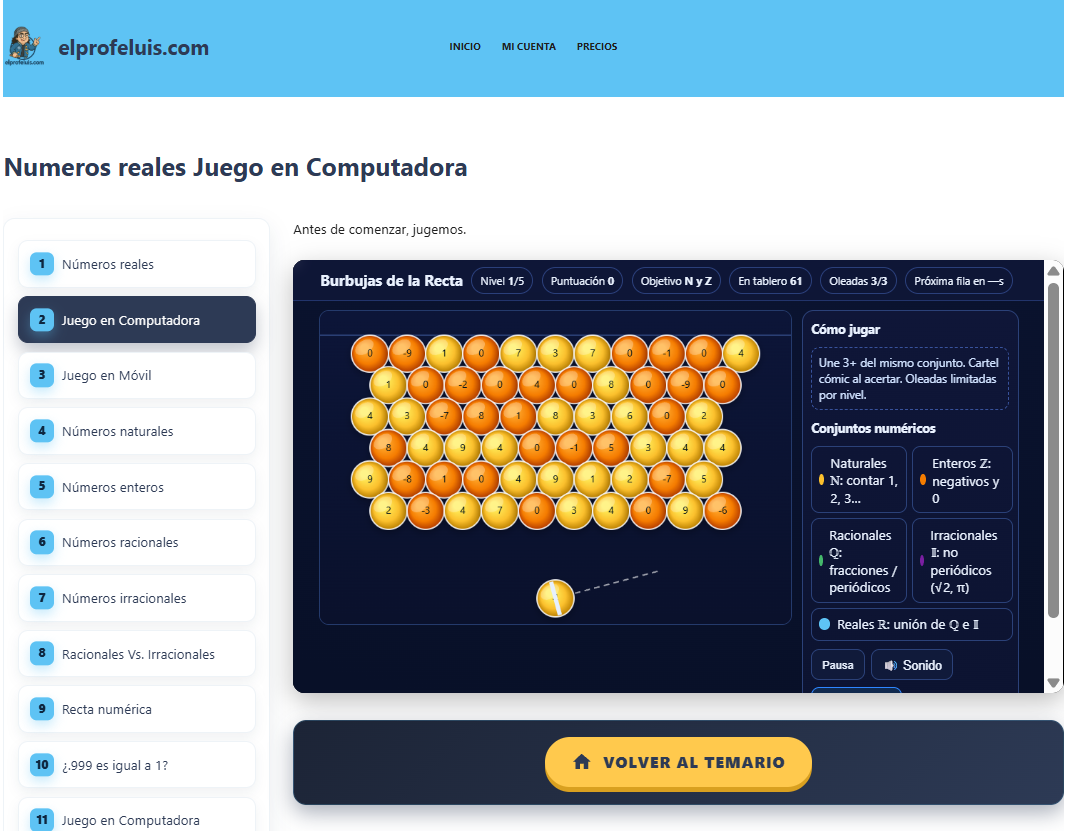
Number placement and classification games to practice arithmetic and algebra.
A replicable format so every new topic follows the same logic.
“Oliver managed to find my essence and put it into an educational platform.”
El Profe Luis — education creator, more than 3 million followers
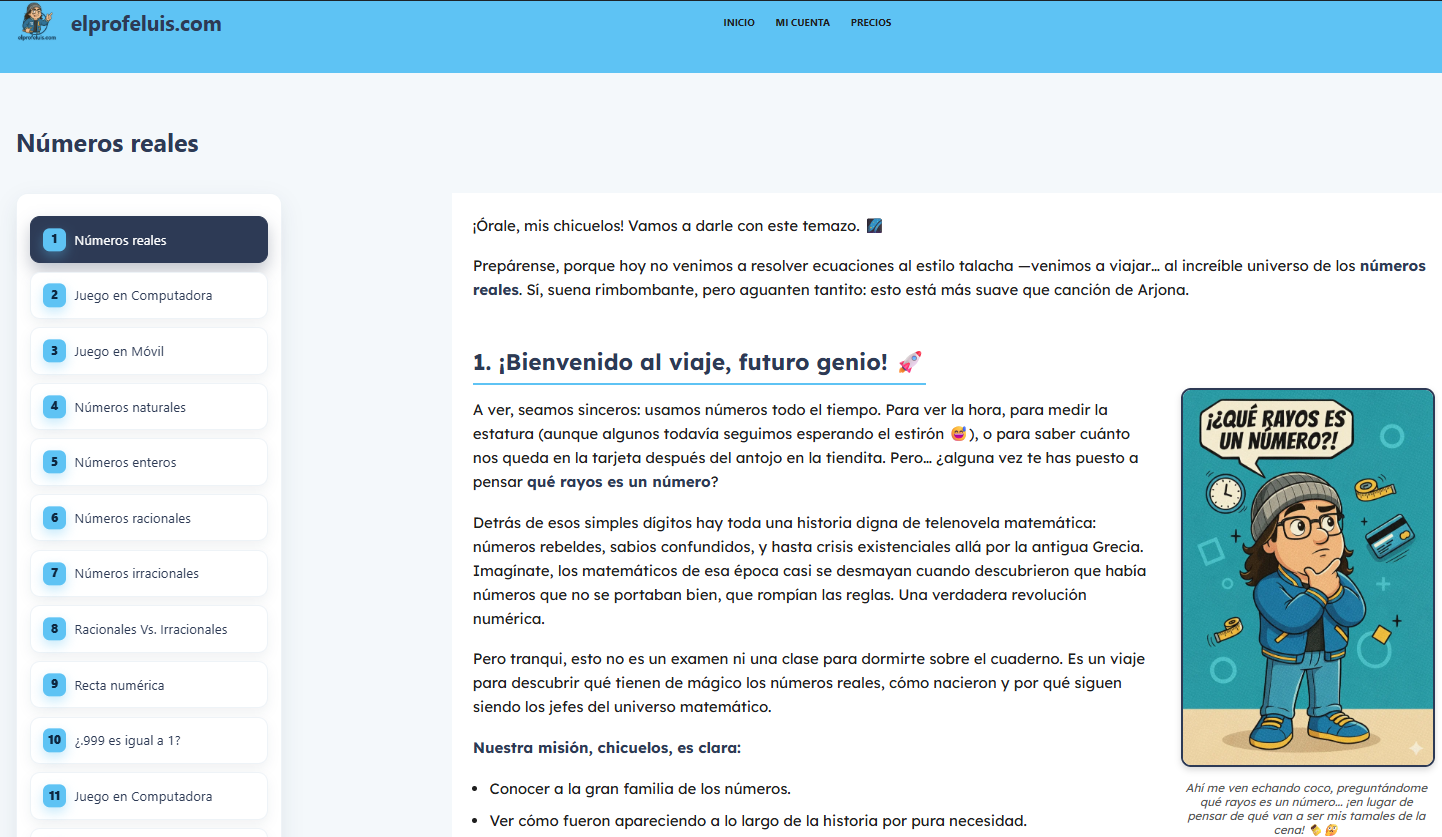
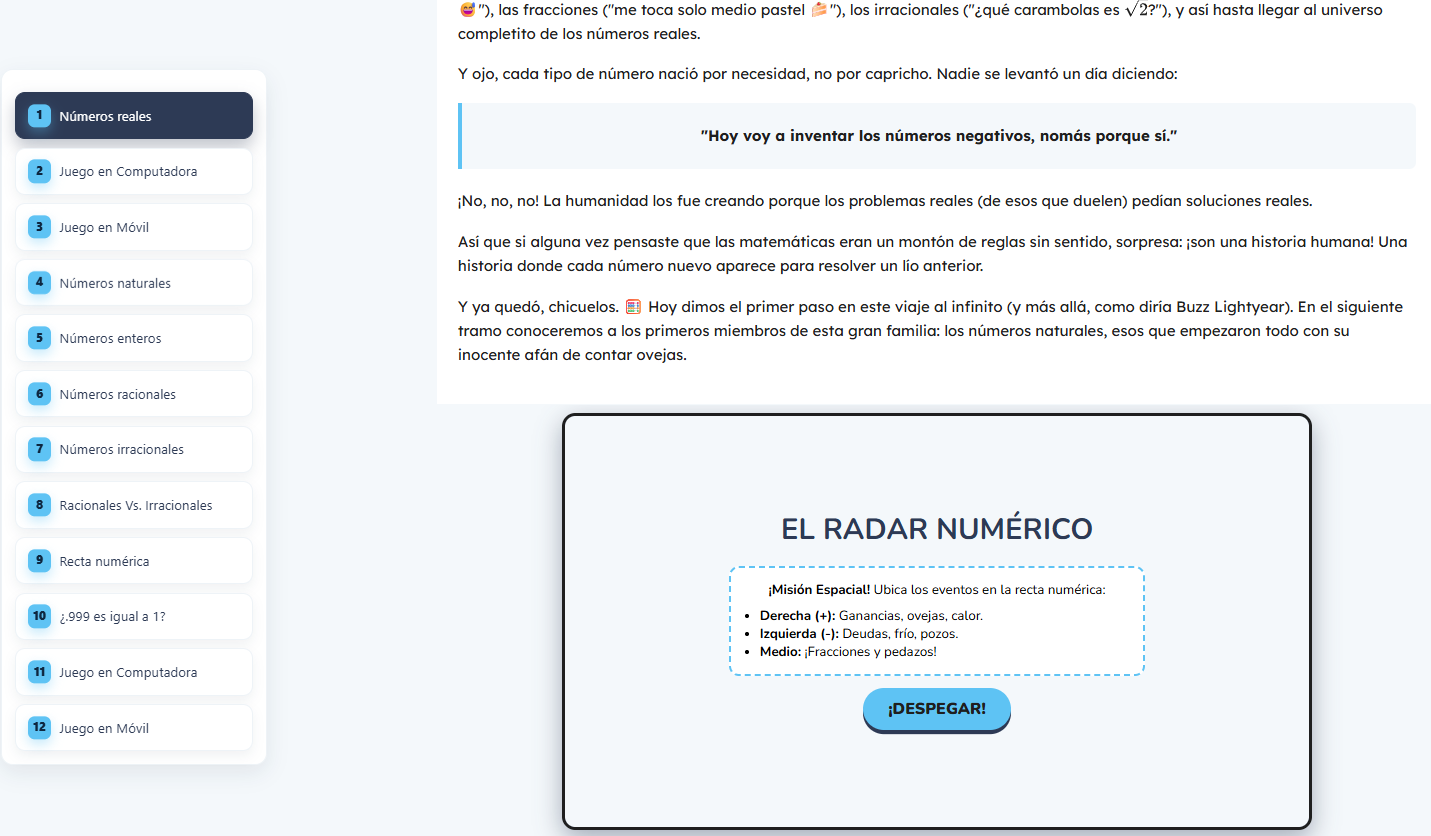
How it looks in production
The pieces integrated into elprofeluis.com, with its navigation and its identity:
The lesson inside the platform: banner, sidebar topic index and class content.Astro-Radar as reinforcement, right after the explanation.Burbujas de la Recta as practice, without leaving the site’s identity.
Try it yourself
The complete first class of the course — with the Astro-Radar game integrated at the end, just as the student experiences it — and a second game we built for the number line topic. Best enjoyed on a computer:
An adult studying for an insurance license, a recruiter examining their own biases and a middle schooler wrestling with the number line have nothing in common. What does repeat is the structure: name the problem, give people something to hold on to, and end in something you do, not something you read.
Technical contentInsurance, AI taxonomies and algebra turned into experiences people actually finish.
Real practiceCalculators, decisions with consequences and games that demand understanding.
In-house productionInstructional design, development and art — without outsourcing the judgment.
Shipped to productionIntegrated into the client’s platform and running with real users.
Tell us what you want to teach and to whom. If your project looks like any of these, we’ll tell you how we’d approach it and what you’d have up and running first.